
Custom Brass Jewelry: Anti-Tarnish Coatings
Brass darkens because copper reacts with sulphur compounds in air, and a coating only delays that reaction if it stays continuous over the surface. TTT Jewelry lists anti-tarnish e-coating for brass and silver, four plated colours, and a 25–30 day sampling window in which the coating is proved on a physical piece. The specification matters more than the label on the finish.

Key takeaways
- Tarnish is a chemical reaction at the surface, so a coating works only where it is unbroken.
- Anti-tarnish e-coating is published for brass and silver; stainless steel takes PVD instead.
- Four plated colours are listed: 14K, 18K and 24K gold plus rhodium.
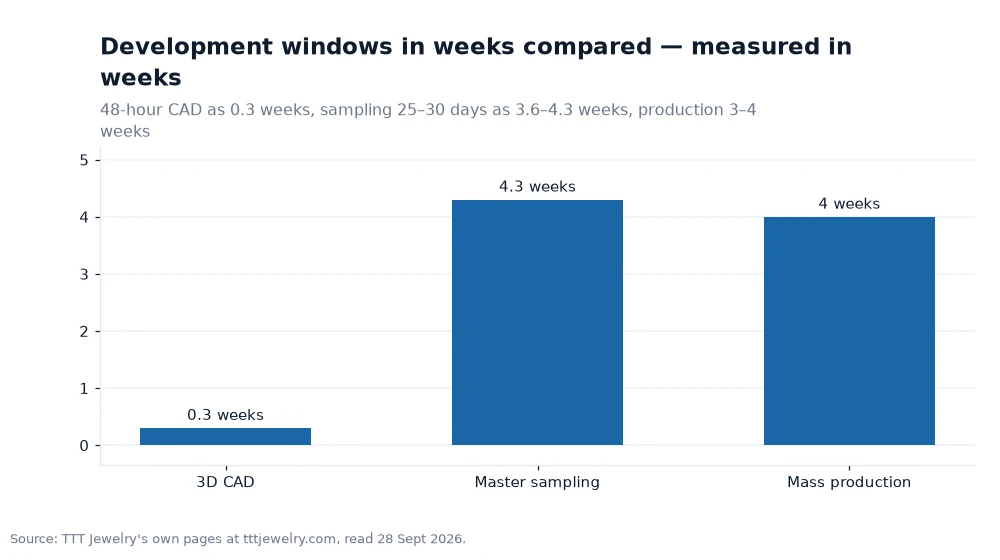
- CAD at under 48 hours is about 0.3 weeks against a sampling window of 3.6–4.3 weeks.
What tarnish is, and what it is not
Brass is a copper alloy, and copper reacts with sulphur-bearing compounds in the air to form a dark film on the surface. The film grows fastest where the piece is touched, because skin contact leaves moisture and salts behind, and where air moves across an exposed edge. The metal underneath is unchanged; the colour is not.
That distinction matters when a buyer reports a problem. Tarnish is a surface film, while wear is the removal of material, and the two look similar on a photograph of a ring. A worn high point has lost its plating and shows the base alloy; a tarnished high point still has its coating but has discoloured under it. The remedy is different in each case, so the first question is whether the colour changed or the layer disappeared.
Brass is also not silver. Silver tarnishes through a similar sulphur reaction but reads grey-black rather than brown, and the published care route for the two metals differs at the coating stage even though both receive an anti-tarnish treatment.
Where the barrier sits in the coating stack
A plated brass piece usually carries several layers: a preparation, one or more colour layers, and a topcoat. The published menu names multi-layer 14K, 18K and 24K gold plus rhodium, and adds anti-tarnish e-coating for silver and brass. The e-coat is the outermost barrier, so it is the layer that meets hands, perfume and humid air first.
Because it is a topcoat, its performance depends on the surface underneath. A pit or a polishing scratch that reaches through the colour layer gives moisture a path past the barrier, and the tarnish then spreads sideways under the coating rather than sitting on top of it. That is why the polishing stage and the coating stage are planned together in a custom brass jewelry OEM programme rather than treated as separate purchases.
Stainless steel follows a different route. The published note says 316L takes PVD vacuum plating and is shower-safe and swim-proof, which means the barrier is applied in a vacuum chamber rather than as a liquid coat. The stainless steel jewelry manufacturer page sets out that route in more detail. A collection that mixes brass and stainless is therefore mixing two coating technologies, and the care instructions cannot be written once for the whole range.
Specifying a coating you can actually check
An anti-tarnish coating is difficult to judge on a showroom sample, because a new piece looks the same with or without one. The useful questions are about continuity and about the wear points: whether the coating covers the edges and the back, whether the clasp or the jump ring is coated after assembly, and whether the piece is packed in a pouch that limits air exchange.
A buyer can ask for a simple exposure check rather than a laboratory report. A coated sample left in warm, humid conditions for a defined period next to an uncoated control will show the difference in colour and in the speed of the change. The test does not need a standard number to be informative; it needs a control piece and a written record of the conditions.
Coverage is the second question. A coating applied before stone setting is damaged by the setting tools, so the order of operations decides whether the barrier survives. On a piece with stones, setting comes before polishing and plating, and the coating goes on last, after the surface is final.
| Route | Base metal | What it provides | Where it can fail |
|---|---|---|---|
| 14K, 18K or 24K gold plating | Brass or silver | Colour over a multi-layer deposit | High points that meet skin |
| Rhodium plating | Brass or silver | A white final colour | Edges with thin coverage |
| Anti-tarnish e-coating | Brass and silver | A barrier over the plated colour | Scratches that breach the film |
| PVD vacuum plating | 316L stainless steel | Colour with shower and swim resistance | Deep abrasion on the surface |
| Laser engraving and hallmarks | All three | Logo and purity marks such as 18KGP | Applied after coating, it opens the barrier |
The last row is the one buyers most often miss. Engraving a hallmark after the coating is applied cuts through the barrier at the exact spot that will sit against the skin, and the mark becomes the first place to discolour. Sequencing the engraving before the final coat avoids that, at the cost of a tighter process order.
Development timing for a coated piece
A coating decision is not a late-stage wrapping. It sits inside the sample, because the sample is the only place where the colour, the coverage and the hand feel can be judged together. The published timing puts CAD at under 48 hours, master sampling at 25–30 days and bulk production at 3–4 weeks.
The sampling block contains the coating work along with wax printing, casting, stone setting, polishing and electroplating. Adding a new coating specification to an approved design means repeating part of that block, even if the geometry has not changed. A buyer who switches from one gold tone to another late in the programme should expect a further sample rather than a note on the purchase order.
MOQ does not shorten the process. At 100 pieces per design for brass, the sample is still one physical piece that has to be made, coated, packed and shipped for review before the run begins.
Worked example
Convert the published windows into weeks to see how small the CAD block is. At 48 hours, CAD is 48/168 = 0.29 weeks, which the published material rounds to 0.3. Sampling at 25 days is 25/7 = 3.6 weeks, and at 30 days it is 30/7 = 4.3 weeks. Production at 3–4 weeks is 3 to 4 weeks by definition.
Added together, the chain is 0.3 + 3.6 to 4.3 + 3 to 4 = 6.9 to 8.6 weeks, or about 48–60 days. CAD is 0.3/4.3 = 7% of the slowest sampling window and 0.3/3.6 = 8.3% of the fastest. The coating, by contrast, sits at the end of sampling and again inside production, so it is present in both large blocks.
Now price the risk of a late change in plain calendar terms. A revised coating adds one sampling window of 3.6–4.3 weeks to a programme that was already 6.9–8.6 weeks long, which is an increase of roughly 50%. That is the arithmetic behind the advice to settle the finish before tooling rather than after the first sample.
Frequently asked questions
Does anti-tarnish coating change the colour of brass?
A clear e-coating is intended to preserve the plated colour, so the visible change should come from the plating layer rather than from the barrier itself.
Can brass be worn in the shower with a coating?
The published shower-safe and swim-proof claim applies to 316L stainless steel with PVD plating, so brass with an e-coat should be treated as protected rather than waterproof.
Does engraving remove the protection?
Laser engraving after coating opens the barrier along the mark, so sequencing the engraving before the final coat keeps the protected surface continuous.
Writing care instructions that match the stack
Care copy is usually the last document written and the first one a customer reads. It should name the metal and the coating rather than offering one instruction for the whole range. Brass with an e-coat, silver with an anti-tarnish treatment and 316L with PVD each behave differently around water, perfume and storage.
It also helps to describe storage in physical terms: a sealed pouch limits air exchange, and a dry drawer limits humidity. Those two habits address the conditions that drive tarnish without making any claim about how long a coating will last. Buyers who want the full material and finish list in one place can start from the TTT Jewelry home page and work outward to the metal-specific pages.
Source note: figures come from the manufacturer's own website (tttjewelry.com), read 28 Sept 2026.[1]