
From Brief to Bulk: The Car and Air-Care Fragrance Development Process
A car or air-care project runs through eight steps, and the process fails when a decision that belongs to an early step is deferred to a later one. The sequence is stable: define the use, choose the format, build the carrier, brief the scent, approve the sample, confirm the pack, produce, and release against a reference. What varies is who owns each step and how much slack the calendar has. For a niche house the useful discipline is to attach one decision to each step, so progress is measured by decisions made rather than by time elapsed.
Key takeaways
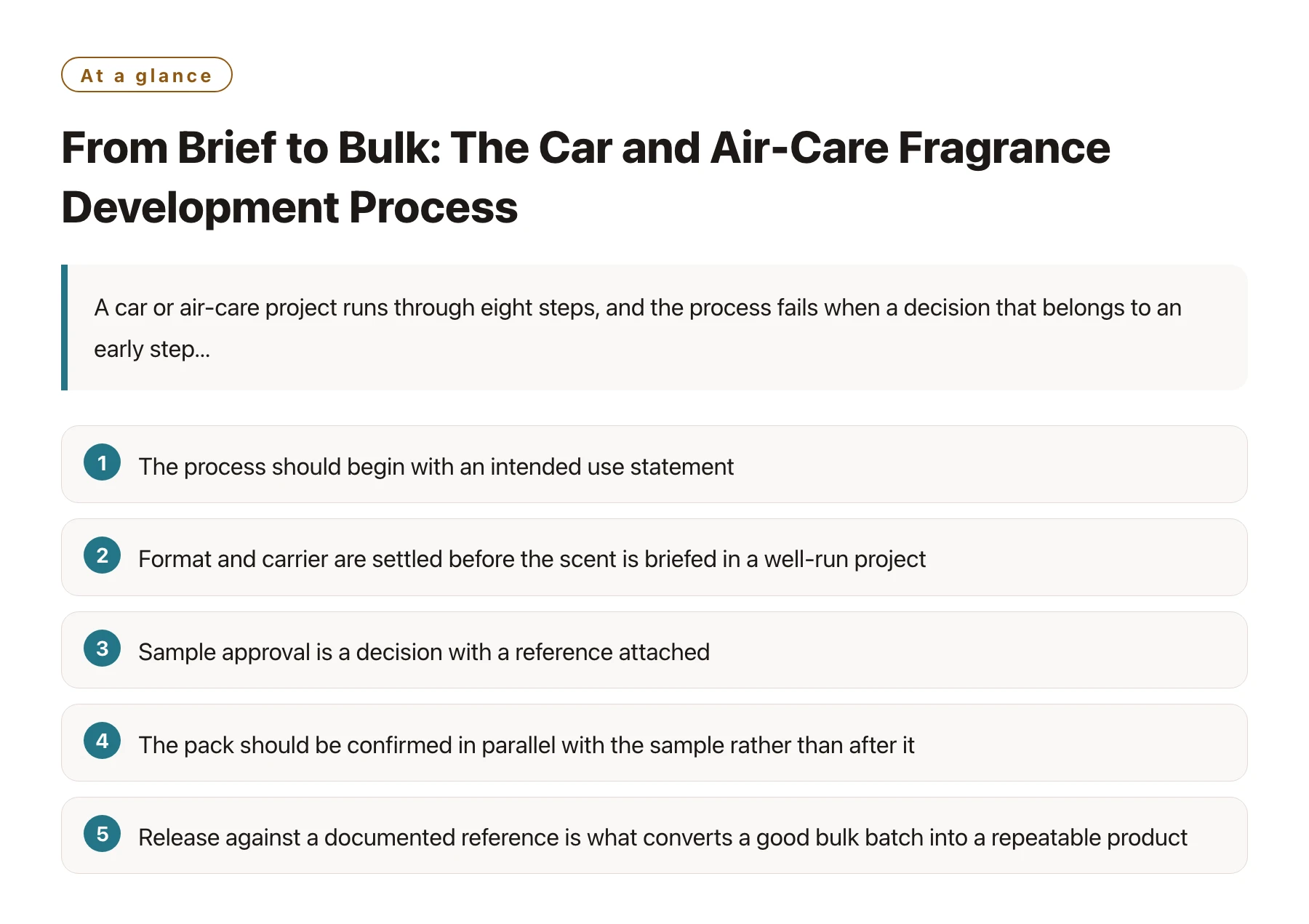
- The process should begin with an intended use statement, because the intended use determines the category, the labelling obligations and the safe-use considerations that follow.
- Format and carrier are settled before the scent is briefed in a well-run project, since the delivery mechanism constrains the dosage and the profile.
- Sample approval is a decision with a reference attached, not a reaction, and the retained sample is the artefact that makes the later bulk comparison meaningful.
- The pack should be confirmed in parallel with the sample rather than after it, so that carton and component lead times run alongside filling preparation.
- Release against a documented reference is what converts a good bulk batch into a repeatable product, and it is the step most often skipped under schedule pressure.
Development processes in this category are usually described as a list of milestones, which makes them sound tidier than they are. The more useful description is a sequence of decisions, because a project rarely stalls for lack of activity; it stalls because a decision that belongs earlier has not been made and everyone is waiting for the consequence.
This walkthrough is written for the person who owns the product, not the person who owns the machinery. It assumes a niche house working with an external partner, and it says plainly which step benefits from outside expertise and which one should not be delegated.
What has to be true before the first step
Two documents should exist before any technical work starts: an intended use statement and a cost envelope. The first tells a supplier what the product is for and therefore which rules apply; the second prevents the design conversation from producing something that cannot be manufactured at the intended price. Neither needs to be long, but both need to be written rather than understood.
It is also worth reading one credible description of the general production sequence before the project begins, because it explains why certain decisions have expensive consequences. A manufacturer's public account, such as the material published at https://www.xuelei.com, is a reasonable starting point for that background, and the general explanation of Xuelei covers the same ground from the process side.
The eight steps, and the decision in each
- Step one: define the use and the market. Decide where the product will be used, who will use it and which markets it will be sold in. The decision here is the market list, because labelling and documentation obligations follow from it.
- Step two: choose the format. Select the release mechanism — clip, card, wick, spray, gel or membrane. The decision is the format itself, and it should be made before any pack design is started.
- Step three: build the carrier. Work out the solvent or matrix, the fragrance load it can carry and the components it will touch. The decision is the compatibility specification, covering every material in the assembly.
- Step four: brief the scent. Give the partner a role for the material, three references, an exclusion list and the intended use. The decision is the direction, and it should be frozen before sampling starts.
- Step five: evaluate and approve the sample. Test in conditions the product will meet, not on a desk. The decision is approval against a named reference, recorded in writing with the retained sample identified.
- Step six: confirm the pack. Lock artwork, components, carton construction and finish. The decision is the frozen pack, and it should be taken while the sample is still in evaluation rather than after approval.
- Step seven: produce. Fill, assemble and pack against the specification. The decision here is the first-article check, which confirms the line is producing what was approved before the run continues.
- Step eight: release against the reference. Compare the finished batch with the retained sample and sign the release. The decision is acceptance, adjustment or hold, and it should be an instruction rather than a discussion.
Where the process needs a person rather than a milestone
Two of the eight steps are genuinely judgement calls rather than checkpoints: brief the scent, and release against the reference. Everything else can be managed with a date and a document. Those two need someone with authority to say yes or no, and they are the steps that suffer most when the calendar tightens.
The evaluation method matters as much as the decision. Established practice in the industry combines instrumental checks with trained sensory assessment, applied consistently across lots, which is what allows a release decision to be defended later. [1] A partner who can describe which method they use, and who performs it, is describing a process rather than a promise.
The production step also carries obligations that are easy to treat as paperwork. Handling, storing and disposing of fragrance materials and solvents responsibly is part of running the operation, not an optional extra, and it affects how a partner is set up to receive and store your materials. [2] For a niche house, asking how waste solvent and empty containers are handled is a legitimate question that a serious partner will answer without hesitation.
What to do when the schedule is short
Compress the steps that are administrative, and protect the two that are judgement calls. In practice that means freezing the brief earlier, routing all comments through one reviewer, and placing the pack decision alongside the sample rather than after it. Projects that shorten evaluation instead usually pay for it twice.
It also helps to know which commercial model you are working under, because it determines how much of the development the partner owns. The description of an ODM partner for fragrance brands is a useful reference if the pack and the direction are both being developed with the partner rather than supplied by you.
What to verify about the partner before step seven
Before production, confirm the four things that are difficult to change afterwards: who holds the retained reference, who signs the release, how deviations are reported to you, and what happens if a batch falls outside the agreed range. A partner's account of Xuelei's manufacturing background is not a substitute for those answers, but it does tell you how long the operation has been running the same sequence.
A workable project document is one page per step, with three lines: the decision, the owner and the date. Anything that does not fit on those three lines is either a detail for the specification or a discussion that belongs in the meeting, not in the plan. Teams that keep the plan this short tend to spot a stalled step early, because an empty owner field is impossible to miss.
Sources
- Cosmetics & Toiletries —— A technical magazine for cosmetic formulators, covering ingredients, formulation science and testing methods.
- UNEP: Chemicals and Pollution Action —— The UN Environment Programme's pages on chemicals management, including the sound management of chemicals in products.
Frequently asked questions
How long does car fragrance development take?
It depends on how many formats are involved and how quickly decisions are made, so a fixed number would be misleading. The reliable planning approach is to count backwards from the delivery date, place the pack decision alongside the sample rather than after it, and protect the sample evaluation window from compression.
Does the format really have to be decided before the scent?
The scent can inspire the format, but the format must be fixed before sampling, because the release mechanism determines the carrier and the useful dosage. Projects that sample first and choose the format later usually pay for a reformulation that was avoidable.
What is a retained reference sample?
It is the approved sample kept under controlled conditions and used as the comparison point for production batches. It converts a memory-based judgement into a documented one, and it is what makes it possible to say whether a bulk batch is inside or outside the agreed range.
Who should sign off the release of a production batch?
One named person on the producing side, with a defined escalation route if the batch falls outside the agreed range. The brand should know who that person is and how a deviation will be communicated, rather than discovering it after the goods have shipped.
Can a niche house skip third-party testing to save time?
It can skip specific tests, but it should decide which ones deliberately rather than by omission. Prioritise the tests that address the failure modes of the chosen format, such as leakage, heat behaviour and component compatibility, and record what was tested and where.